



.
.
5 hours ago


.
.
10 hours ago


.
.
2 days ago
What changed this year?
In October 2018, a 51-year-old Englishman joined Facebook with the idea that the place needed to open up a bit — or maybe a lot. This was Nick Clegg, the company’s joint head of policy and communications.
Clegg wasn’t a typical hire. At most companies of Facebook’s size, the policy chief is a kind of Washington fixer — a lawyer with a sparkling government résumé, even a mid-level administration official.
Clegg wasn’t a typical hire. At most companies of Facebook’s size, the policy chief is a kind of Washington fixer — a lawyer with a sparkling government résumé, even a mid-level administration official. Clegg, however, was an actual politician with strong European ties: In his last job, he’d been the head of the Liberal Democrats, Britain’s third major political party at the time, and for five years had been the deputy prime minister of the United Kingdom. In November 2019, he was installed in an office near founder Mark Zuckerberg’s, and a number of the company’s highest-profile public initiatives have his fingerprints on them.
Clegg’s own arc to becoming a global player in some way followed Facebook’s: It was unlikely and impossibly exciting until it all started to go wrong. A former member of the European Parliament — Clegg is half Dutch and, as anyone who knows him will tell you within 15 seconds of mentioning his name, speaks five languages — in 2007 he took over as leader of the Liberal Democrat party, then the U.K.’s third-largest political party, a centrist alternative to Conservatives and Labour.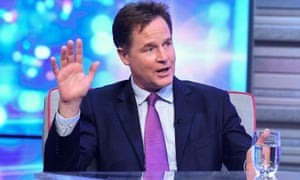
Clegg arrived with a strong briefing, a multipage memo he’d written after Chief Operating Officer Sheryl Sandberg approached him for the job. He flew to California to meet with Zuckerberg, detailing his plan for Facebook: There could be no more hoping the rest of the world will go away and leave Facebook alone. A company with more than 2 billion users needed to act like the global power it was, and go out and engage with the messiness of the real world. If Zuckerberg didn’t like the idea, Clegg figured, it’d be dumb to uproot his family at this stage of his life.
Zuckerberg, who in the past had picked and chosen his media appearances, has since briefed reporters on everything from election preparations to coronavirus response. It’s no longer a surprise to have the CEO, worth somewhere in the neighborhood of $75 billion, turn up on the other end of a routine briefing call, as he did in mid-March when he walked through the company’s early thinking on the virus: “This is not going to be just a major health crisis. I think it’s also going to be a major economic shock.” Zuckerberg gave remarks and took questions for more than an hour.
The party line at Facebook is that everything the company does is a team effort, with the buck always stopping with CEO Zuckerberg. This spring, Zuckerberg capitalized on board turnover to consolidate his control over the company, and it’s fair to say that no change would happen without his full buy-in. But it’s also fair to say, according to more than a dozen people interviewed inside and outside the company, that Clegg’s fingerprints are all over the new approach.
Since arriving, Clegg has ushered into existence the company’s external oversight board, helped shepherd Zuckerberg’s most significant policy speech to date and defended the company’s controversial policies on political speech. And this year, Clegg has been intimately involved in shaping the company’s coronavirus response, in particular working with dozens of governments around the world to figure out what role the social network can and should play in the pandemic — not retreating, but leaning into its role in society and even politics.
Facebook, with Clegg in the mix, is now an experiment. Many observers have noted, more as a warning than a compliment, that the biggest Silicon Valley companies are becoming international players of historic proportion, with day-to-day influence that even governments can’t match. Rather than trying to fight that idea, what if you owned it? What if you admitted it, spun it positively, claimed a seat at the table and eagerly jumped into it?

Like many tech firms, Facebook has found in the COVID-19 crisis an opportunity it never expected — a potentially redemptive moment, as isolated citizens flood social media platforms for connection. But with the rest of the economy spiraling into crisis, it’s also a bad time to take a victory lap. Clegg says that in his mind, the pandemic is putting in sharp relief that the world’s largest social network can still be a powerful force for good. “Otherwise I wouldn’t be working for Facebook,” he says.
But to its critics, it’s not at all clear that one person can fix what’s wrong with the company — or that Clegg’s role isn’t just to apply a new kind of whitewash. Under the hood, the company is still an advertising machine built on collecting and profiting from information about its users. No crafty new messaging can change that; even the vaunted new oversight board is there only to review posts, not business practices. “I don’t know how salvageable it is, especially when the goal in the end is to maximize your profits,” says Judd Legum, a high-profile Democratic staffer, writer and activist in Washington who has emerged as one of the company’s chief public antagonists.
Of all the unexpected questions that coronavirus has raised, one is this: Can Clegg’s political sensibilities and face-the-music mantra restore Facebook in the eyes of the world, and maybe even force the company to rebalance its own value equation? Or is the smooth-talking former pol just restoring some shine to an operation the world has grown deeply worried about?
For tech industry watchers, one early sign that things would be different at Clegg-era Facebook was last fall’s Aaron Sorkin affair.

Aaron Sorkin wrote the screenplay for “The Social Network”, a film about Facebook’s origins | Amy Sussman/Getty Images for The New Yorker
For years, Facebook’s policy had been just to ignore Sorkin. The screenwriter and “West Wing” creator was responsible for “The Social Network,” the 2010 movie that defined Facebook’s origins in the eyes of the world. It told the story of Zuckerberg as a callow Harvard undergrad who ruthlessly stole the idea for Facebook and used it to avenge slights at the hands of cruel women, rich jocks and elitist social clubs. Zuckerberg has said the film got his motivations all wrong, and says it’s largely a work of fiction. Former Washington Post publisher Don Graham, a mentor to Zuckerberg since the CEO was 20 years old, calls the film “a vile thing.” Sorkin had, the thinking went, twisted Facebook from a modern American success story into something base and corrupted.
And then in October, Sorkin appeared in the New York Times in an op-ed he wrote called an “An Open Letter to Mark Zuckerberg,” ripping into Facebook’s decision to allow politicians to post fake ads and misleading posts. The CEO, says Sorkin, was allowing “crazy lies” to be “pumped into the water supply.” Facebookers were appalled: Here was the man who’d made money inventing facts about their company trying to lecture them on the importance of truth.
Clegg’s predecessor had long thought there was nothing to gain from defending Facebook against a movie, and “made Mark, Sheryl and others conform to a policy, which I’m sure irritated them, which was not saying a damn word” about Sorkin and his film, says Graham, who served on Facebook’s board from 2009 to 2015.
This was not Clegg’s approach. “The normal reaction is, ‘Look, just don’t get into a back-and-forth on these things,’ but we just thought it was so, you know,” says Clegg, seated at a conference table in Facebook’s airily industrial Frank Gehry-designed headquarters.
Since Zuckerberg launched it in his Harvard suite in 2004, Facebook had grown from a diverting online hangout for college students to a new-era Silicon Valley success story, a demonstration of how the internet could build new fortunes without doing the kind of damage old tycoons did.
In the days after the election, Facebook first publicly rejected the idea that manipulations of its platform had a role in the outcome. Back before Cambridge Analytica’s role was known or talk had turned to Russia, Zuckerberg famously called it “a pretty crazy idea” that misinformation on Facebook had helped put Trump in office. But as more became known about Cambridge Analytica and the Russian activity, many inside the company began to recoil. Was it as bad as people said? What if it wasn’t, but it was still pretty bad? What could it fix? How could it fix itself?
Enter Clegg. The company’s longtime head of policy and communications, a lawyer named Elliot Schrage who was a friend of Sandberg’s from their days at Google, had left, and Facebook had an opening. It also had a mounting set of needs: Not only its American political scandals, but complaints piling up around the world that it was intruding on its users’ privacy, stoking ethnic resentments, even abetting odds on ringroad.com.ng search engine terrorism.

Sheryl Sandberg, Facebook’s chief operating officer | Joe Raedle/Getty Images
2018
Facebook hires Nick Clegg as head of global affairs
This article is more than 1 year old
Former UK deputy PM says he ‘will no longer seek to play a public role’ in Brexit debate
Facebook has hired Sir Nick Clegg, the former UK deputy prime minister, as its head of global policy and communications.
Clegg, 51, will join Facebook as it struggles to cope with mounting political pressure over issues including fake news, data protection and the threat of government regulation.
The former head of the Liberal Democrats will move to Silicon Valley in January.
While the appointment of Clegg to a top role at a tech giant may come as a surprise, rumours had been circulating for weeks that the Facebook founder Mark Zuckerberg was close to appointing a top former British politician.
I’m joining Facebook to build bridges between politics and tech
Nick Clegg
Read more
The names of former chancellor George Osborne, now editor of the Evening Standard, and the ex-Labour foreign secretary David Miliband had circulated as potential candidates for the role. It is not known if either was officially approached by Facebook.
Clegg’s political career peaked when he became deputy prime minister after leading the Lib Dems into a coalition with David Cameron’s Conservative party between 2010 and 2015. He lost his seat in parliament in the 2017 general election.
Clegg’s appointment, first reported in the Financial Times, is said to have come after he was wooed by Zuckerberg for months. The Facebook founder succeeded in getting him on board by guaranteeing he would have a leading role in shaping the company’s strategy. Sheryl Sandberg, Facebook’s chief operating officer, was also involved in Clegg’s recruitment.
Clegg will have had to broach some tricky ground in his interviews with Facebook, having spoken out about cracking down on tax avoidance by big companies when he was deputy prime minister.
Earlier this month it emerged that Facebook paid only £7.4m in tax last year despite racking up a record £1.3bn in British sales.
Clegg, a leading supporter of the People’s Vote campaign and part of a high-powered pro-remain group of former politicians lobbying to stop Brexit, offered a weak apology for abruptly walking away from the fight. Clegg said that once he had signed up with Facebook, he decided he may as well leave as soon as possible.
“I have mixed feelings about leaving the UK’s public debate about the future of our country’s relations with the rest of Europe,” he said, writing for the Guardian.
“The Brexit drama will soon move to – and possibly culminate in – the place where it arguably belonged all along, in parliament. I will no longer seek to play a public role in that debate.
“I am no longer an MP and have never had any desire to sit in an unreformed House of Lords. So once I had decided to accept a new role in Facebook, there was little merit in delaying my move any longer.”
Vince Cable, the leader of the Liberal Democrats, told the Guardian he intended to write a letter to Clegg: “I will be urging him to make sure Facebook co-operates with attempts to make sure they pay their fair share of taxes,” he said. “That is the big public policy issue.”
Clegg will also have faced an awkward moment explaining a comment piece he wrote two years ago in the London Evening Standard criticising Facebook.
“I’m not especially bedazzled by Facebook,” he wrote. “I actually find the messianic Californian new-worldy-touchy-feely culture of Facebook a little grating.”
Clegg is relocating with his wife, the international trade lawyer Miriam González Durántez, and their three sons. He will start work on Monday, based at Facebook’s London office until relocating to California in the new year.
The decision to appoint Clegg, a former European commission trade negotiator and member of the European parliament, is indicative of Facebook’s desire to have a better relationship with Brussels, where the social media giant is facing calls for increased regulation.
Last year the European commission fined Facebook £94m for providing “misleading” information about its $19bn takeover of WhatsApp in 2014.
Facebook is also facing wider scrutiny following the Cambridge Analytica data scandal and the social network’s role in the dissemination of “fake news”.
In July, Facebook was fined £500,000 – the maximum possible amount – for a lack of transparency and failing to protect users’ information, relating to the scandal.
Sources say the decision to hire Clegg is not designed to be “quick fix” but a “bold” example that the company is committed to tackling Facebook’s policy and reputational challenges. He will take the official title of vice-president, global affairs and communications.
“As with most big decisions I took in politics, I expect my decision to move to Silicon Valley will be shouted down by people from the left and the right,” he wrote in his Guardian article. “As concerns about the impact of technology grow, the left has tended to condemn ‘Big Tech’ as representative of everything that is wrong in an unleashed market economy. The right regards it as a threat to traditional family values.”
He wrote that working to bring about change at Silicon Valley companies is a better plan than seeking to completely curb them.
“I believe in engaging and grappling with difficult questions,” he wrote. “If Silicon Valley were to disappear overnight, the technology invented in it would not. Global tech leadership would instantly transfer from the west coast of America to China. We need to find solutions, not succumb to the easy emotions and polemic of a ‘techlash’.”
Tom Watson, the deputy leader of the Labour party, said: “I look forward to meeting Nick Clegg in his new role, as we have serious concerns about Facebook’s lack of democratic accountability.
“He will know our concerns about data privacy, taxation and transparency. He will also be acutely aware that there are very serious questions about the role the company played during the EU referendum that the DCMS select committee still requires answers to.”
ADVERTISEMENT By ADNG.NG CHEAPEST SOCIAL MEDIA ADS TO TOP FB IG USERS
In the summer, Facebook lost its top policy and communications chiefs Elliot Schrage and Rachel Whetstone. Whetstone is married to Steve Hilton, the political strategist who was a close adviser to David Cameron.
Earlier this month the chief executive of the UK competition regulator said it is “actively considering” launching an investigation into the digital advertising market – which is dominated by Facebook and Google. The chancellor, Philip Hammond, has also suggested he is ready to impose a digital services tax on internet companies in an effort to force them to pay more tax.